


Francis Crick’s thoughts had such weight that they turned into utterances all by themselves.
In 1958, Crick said this: DNA is the repository of biological information, and that information only flows in one direction, to the creation of proteins. Once that information is used to make proteins, it cannot be retrieved from proteins to make DNA. Put a simpler way: DNA → proteins, but proteins do not → DNA. There has never been machinery discovered in any organism that can extract DNA sequence information from proteins, and there are a series of practical hurdles that would make it exceptionally unlikely. Therefore: DNA can only be made from copying another molecule of DNA. This unidirectional flow of information is what is called now the Central Dogma.
Actually Crick was self-important enough to coin the phrase himself in a 1958 paper, perhaps riding high enough on the hog to do so after he and James Watson published the double-helix structure of DNA that won him the Nobel Prize in 1953. Nevertheless, Crick’s idea acts as a foundation for understanding how biology works on a molecular level, if we think about biology purely as a system for transferring information from one generation to the next.
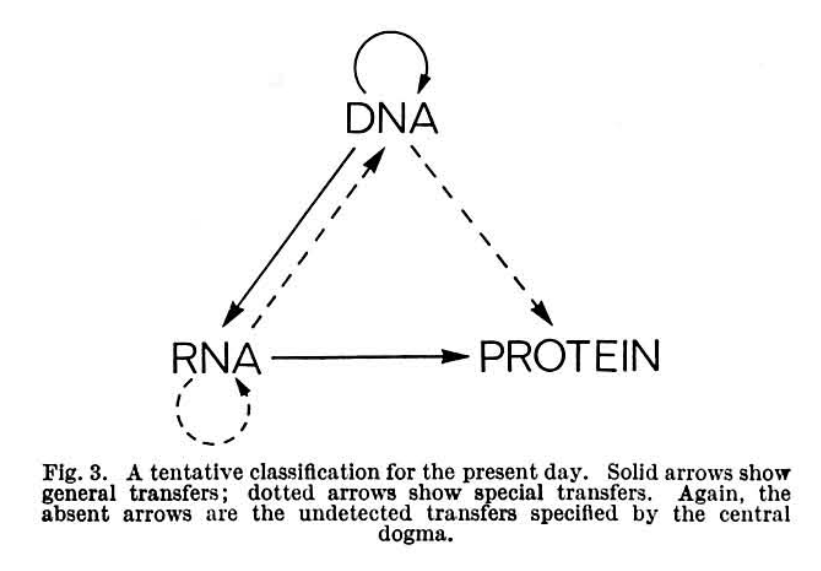
Does, then, the publication of a new paper (in Science on April 16) challenge biology’s foundational arrow diagram? Can the discovery of a new type of protein that contradicts the fundamental assumption inherent in the Dogma change how we view biology forever after? Does this change the very meaning of lif–
“No,” says Alex Gao, assistant professor of biochemistry at Stanford University and lead author on the paper. Gao and his coauthors studied in this new Science paper a type of immune system in bacteria, a module called Defense Associated Reverse Transcriptase Type 3, or DRT3. Bacteria are crowded with bunches of mechanisms to fight off infection from viruses, the most famous of which is CRISPR, which I will not tarry to explain here. But there are “upwards of dozens of DRTs,” Gao said in an interview, many of which, like DRT3, are uncharacterized.