

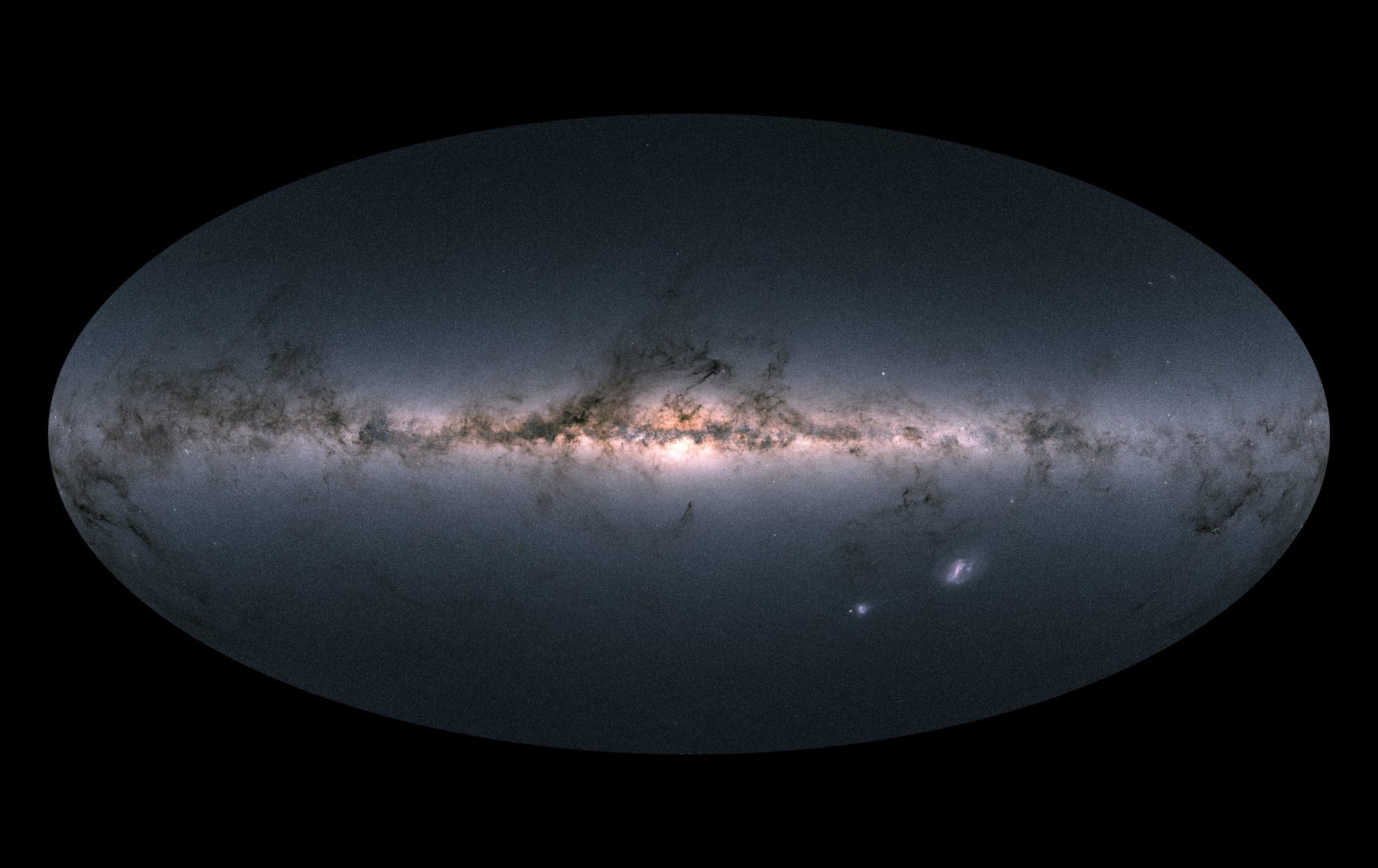
After more than 11 years, the European Space Agency space satellite Gaia fell silent on March 27th, 2025. It set sail into the cosmic ocean on 19 December 19th, 2013 with the mission of creating a map of our galaxy 500 times more accurate and 10,000 times larger than its predecessor. While scientists await the final data release scheduled for late 2030, the information Gaia has already sent back to Earth is revolutionizing astronomy.
Gaia wasn’t just an orbiting telescope; it was a prolific star cartographer. (Its name can be somewhat confusing — the star-gazing mission has nothing to do with observing Earth. And Gaia used to stand for "Global Astrometric Interferometer for Astrophysics," but after a design change it was no longer an interferometer. The name stuck though — hence it's Gaia, not GAIA.) Throughout Gaia’s lifetime, it combined astrometric measurements of positions, parallaxes, and proper motions with other data, like temperature and chemical compositions, on almost two billion objects in our star system. The mission's goal was ambitious: to unveil the origin and evolution of our galaxy.
The first person in the Western world who systematically cataloged stellar positions was Hipparchus of Nicaea, who lived in the 2nd century BCE on the island of Rhodes in the eastern Mediterranean. In 1989, Europe would launch the world’s first space mission dedicated to astrometry, measuring the position and movement of stars as Hipparchus had done more than two millennia earlier. It was only fitting to name the telescope Hipparcos, after the father of this field from over two millennia ago.
Technology quickly improved, with new innovations allowing for further views. Scientists were quick to realize that that the Hipparcos’ mission was barely scratching the surface of discovery with its limited visual range. Just five years after Hipparcos left Earth, ESA scientists proposed an order-of-magnitude more ambitious project named Gaia. While Hipparcos surveyed celestial objects 650 light years away from our solar system, Gaia's reach would extend almost a million times further, past the Milky Way. Across every benchmark, Gaia was designed to one-up Hipparcos, from its detection capabilities for the number of objects observed, to the precision of measurements, to the range of coverage.
Like Hipparcos, Gaia scanned the entire sky once every six months, measuring the character of starlight as it went. Over its 11-year lifetime, it collected Gaia transmitted about 142 terabytes of compressed data to Earth, the equivalent of 35.5 million high-resolution Instagram images.
Gaia was operated with exquisite accuracy in the visible band. To understand Gaia's incredible precision, imagine a buzzing city on the moon. A viewer with an amateur telescope would be make out geologic features like seas, mountain ranges, and even craters several miles across, as well as the blobs of civilization. A giant telescope in one of the modern observatories, like the 33-foot Keck Observatory in Hawai’i, could distinguish individual neighborhoods.
If Gaia were pointed at that city, it could track an ant crawling across a person’s hand, all the way from Earth.
Other telescopes, like the Hubble Space Telescope, have Gaia’s level of accuracy but not its field of view. Essentially, each gaze beholds just a sliver of sky. On the contrary, Gaia sees both far and wide, capable of picking out celestial objects from a sea of stars and accurately pinpointing their location among their close neighbors — and again for every neighbor. It is exactly this property that enables it to produce a global map of the sky.
Such a feat is only possible after overcoming vast engineering challenges. Gaia was equipped with custom-built light sensors — like those in digital cameras and smartphone cameras — and assembled 106 of them to create the largest detector ever built for space, totaling about one billion pixels and spanning roughly the size of a coffee table (more than 100,000 times larger than the light detector of a high-end camera).
Like most telescopes, one of the main obstacles to Gaia's precision was thermal disturbance. Temperature fluctuations from sunlight, for example, could cause Gaia’s parts to expand or contract, warping alignment of the optics and throwing off measurements. To solve this, engineers designed a heat shield to protect the instruments from solar radiation. It maintained a very uniform temperature throughout Gaia’s body, with variations of a few tens of millionths of a degree, as if the spacecraft was immersed in a cold bath. When open, the heat shield gave Gaia its characteristic “top hat” look.
As another engineering challenge, Gaia had to hold completely still — any tugs from radiation pressure, solar wind, and planetary gravitational effects had to be countered so that Gaia could steadily sweep across the cosmos and track relative position of astral objects accurately. So, engineers paired traditional rocket engines, which are comparatively jerky, with a cold gas micro-propulsion system capable of giving extremely small nudges for smooth, fine-tuned adjustments.
Gaia brought in a deluge of measurements, so much so that processing the data required of some of the world's most powerful supercomputers.
And the science buried in the data was illuminating. Gaia mapped over 1.8 billion stars, galaxies, black holes, asteroids, and planets. For each target, Gaia also measured its velocity, color, composition, and temperature. Until Gaia opened for business, over 99.9% of objects it measured was the first time that scientists had ever pinpointed their location in the night sky.
The data allowed scientists to essentially "rewind the tape" on how the Milky Way formed. Similarities in the subtle motions of groups of stars can reveal their shared provenance — perhaps they came from the same stellar nursery, or were a remnant of another galaxy fatally colliding with the Milky Way. Thanks to Gaia’s sharp eye, scientists have been able to infer the Milky Way’s violent history from measuring the current arrangement of stars.
Gaia was a celestial hunter, revealing all kinds of objects that fill our universe. Thanks to Gaia, scientists identified a mass exodus of 1,000 stars fleeing the Milky Way in helter-skelter fashion for reasons unclear, perhaps swept along by supernovae outbursts. Gaia also discovered enormous black holes, including a behemoth 33 times heavier than the sun, and found thousands of asteroids in our solar system, helping astronomers to more accurately predict potential orbital collisions with Earth.
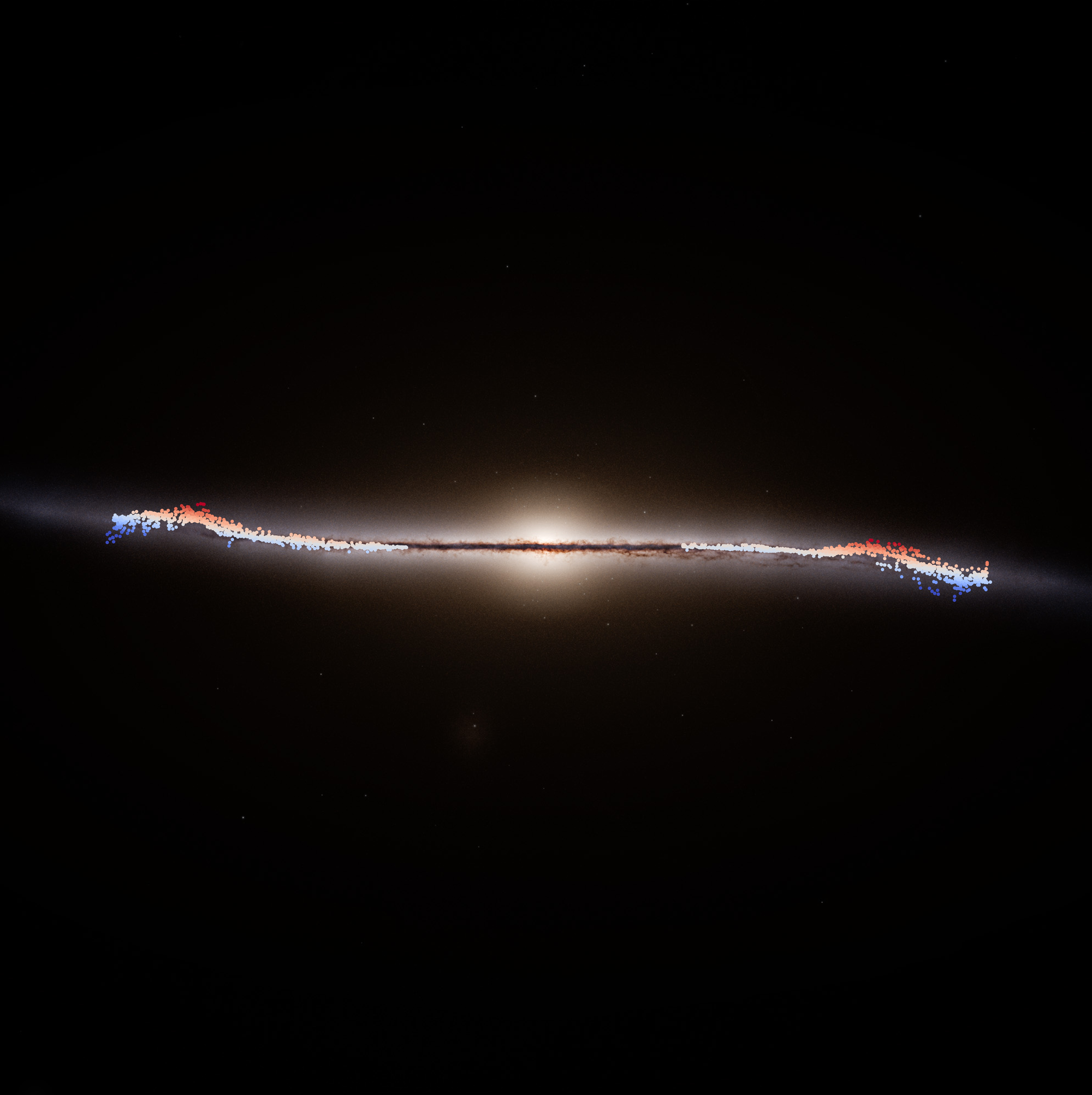
Among Gaia’s most spectacular achievement was the discovery of the “Great Wave” a cosmic wobble in the Milky Way. Here, a great strip of galactic residents — stars between 30 and 65,000 light-years from the galaxy’s beating heart — rise and dip below the plane of the Milky Way, the stellar equivalent of a crowd performing a “wave” in a stadium. Its true origin is still a mystery, but scientists theorize that perhaps the Milky Way is still rippling 10 billion years after a dwarf galaxy smashed into it.
In January 2025, with its cold gas propellant for its propulsion system nearly exhausted, Gaia completed its primary scientific program. Gaia was moved to a retirement orbit and shut down in March 2025. The 4.5-meter-long (15 feet) spacecraft remains in its original orbit 1 million miles behind Earth away from the sun, its eyes closed.
But Earthlings haven’t heard the end of Gaia just yet. Another 500-terabytes of data that Gaia collected in five years will be released by the end of the year. One more trove of data will be released in 2030, the last of Gaia’s 11 years of observational data. It’ll be enough to keep astronomers busy for several decades into the future.
(Dr. Alberto Vecchiato is a researcher at the Astrophysical Observatory of Turin, Italy. His research interests are astrometry and theories of gravity, and he has been working for about 20 years on the Gaia mission. He is also committed to the education and popularization of astronomy.)

