


Until 470 million years ago, a time when our planet was warmer and wetter, plants were confined to oceans. They resembled today’s green algae. They had no roots and wouldn’t evolve any until at least 50 million years later. In order to mine nutrients from the rocky earth, plants instead relied on fungi.
Today, in the cold tundra of northern Alaska, plant-fungus partnerships quietly dominate the landscape. Similar partnerships exist around the world, but the specific fungi here may be like nowhere else. “We identified the tundra as a hotspot of the diversity of these organisms,” said ecologist Michael Van Nuland. Van Nuland’s team invited me to join them in Alaska as they traveled down the Dalton Highway taking census of the soil.
Today’s mycorrhizal fungi live in the earth and attach to plant roots with fine, long filaments called hyphae. These pale threads act as (often microscopic) channels for nutrients. Mycorrhizal fungi burrow into crevices, tap into air pockets, pools of moisture, and sources of nitrogen and phosphorus. Hyphae expand as they trade their loot with their plant hosts in exchange for carbon, laying hyphae down like railroad tracks in any available nook.
Underground microbes lack the charisma of other organisms indispensable to Earth’s ecosystems like giant trees or toothy animals in jungles and deserts, but they are emerging into a clearer picture of Earth’s ecology where the soil fungi serve as the bedrock of their local plots and, possibly, beyond.
“What does that universe under the surface look like?” said Edith Hammer, a microbial ecologist at Lund University not affiliated with Van Nuland’s team who studies how fungi interact with the environment.
For four days, they yanked dark, cold cores of soil, based on predictions that this stretch of the world may harbor undiscovered species. The team was rushing to catalog fungal species on every continent before climate change warps populations beyond recognition.
Their mission was to map diverse lifeforms by collecting soil samples in the hope that they were full of root-dwelling “mycorrhizal” fungi. DNA sequencing would reveal who’s actually down there — and how they’re shaping the much larger lifeforms aboveground.
“These places are real, and out there, and huge,” Van Nuland told me for a Quanta Magazine story about his team’s journey. “And vital to the functioning of the planet and our wellbeing as people.”
 Max G. Levy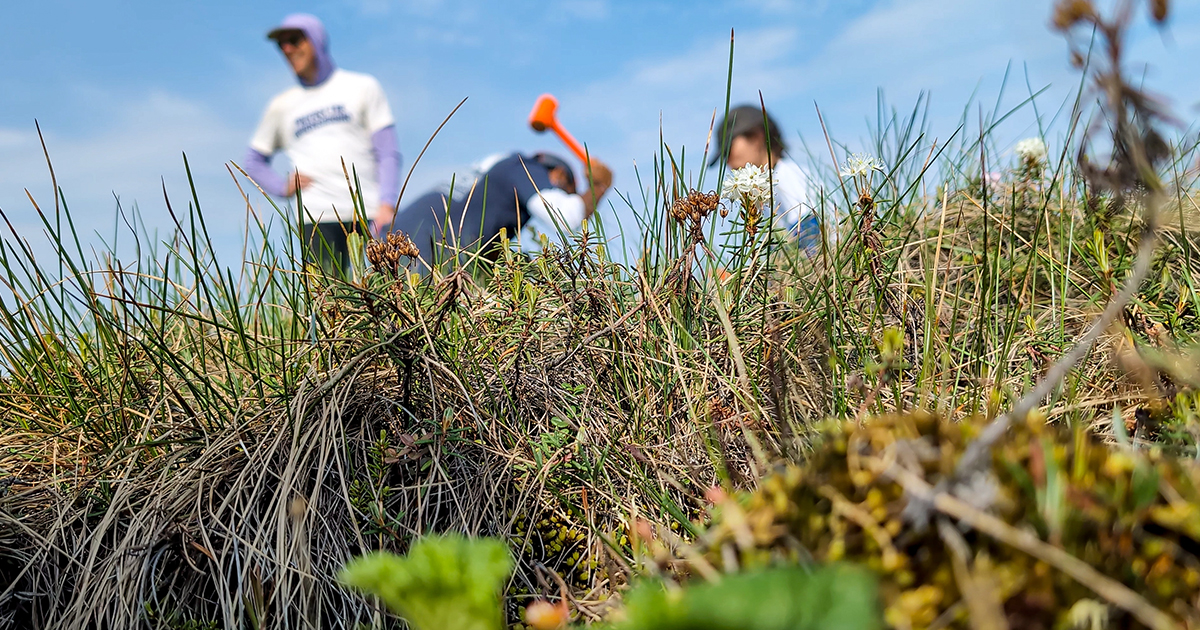
(Max Levy)
‘They’re Doing Something Different’
In the late 19th century, botanists reported tiny fungal structures inside the roots of tropical orchids. In other plants, they found thin strands, the hyphae, that they traced along to fungal spores. They assumed at first these fungi were infectious parasites. French botanist Pierre Augustin Dangeard at first branded some rhizophagus, or “root eater.”
“People couldn't believe that these fungi were actually penetrating into plant cells and not taking something,” said Toby Kiers, an environmental biologist at Vrije Universiteit Amsterdam and the cofounder of the Society for the Protection of Underground Networks (SPUN), which led the Alaska expedition.
“It was a truly seductive story in a way that I think kind of channeled our thinking, and maybe made us dismiss other ways of how forests might work.”
The myth persisted for a century. In the 1990s, scientists designed experiments that pitted mycorrhizal plants against those lacking fungus to measure which grew larger. One study found 8 of 11 plants “were almost completely dependent” on mycorrhiza to survive.
“It began with having to convince other scientists that mycorrhizal fungi were not pathogens,” recalled Justine Karst, a forest ecologist at the University of Alberta. “They’re doing something different.”
Hungry fungus
Mycorrhizal fungi forage. One guild, called arbuscular fungi, will pierce directly into plant cells to establish an exchange of nutrients: plant carbon trickles down to the fungus, while water and other nutrients flow back to fertilize leafy growth above. Another guild, called ectomycorrhizal fungi, uphold this partnership by digesting nutrients they find in the soil. It’s a winning strategy: ectomycorrhizal lifestyles have evolved in previously non-symbiotic fungi some 80 separate times. Their hyphae literally, physically hold soil together while siphoning nitrogen and phosphorus — fodder for both their own expansion and commerce with plants.
Even after finally understanding such roles, 21st century biologists still only perceived mycorrhizal fungi through the lens of their benefit to plants. It was as if, yes, mycorrhizal fungi were indispensable in soil, but only insofar as they supported surface-dwellers.
This plant-centric lens crescendoed with the wildly popular 2015 book The Hidden Life of Trees, which casts forests as social networks where separate trees communicate through the fungi interconnecting their roots. Researchers have referred to this interconnection as “common mycorrhizal networks” or the wood-wide web. They have supposed such networks help nourish seedlings and protect neighboring trees.
“It was a truly seductive story in a way that I think kind of channeled our thinking, and maybe made us dismiss other ways of how forests might work,” Karst said.
Nutrient flow through mycorrhizal hyphae (Loreto Oyarte Galvez VU Amsterdam AMOLF)
In 2023, Karst analyzed decades of forest studies and found little evidence of “widespread” continuous channels that connect separate trees. She also found no conclusive evidence that trees funnel resources or warnings to their offspring through a shared fungi. (Key common mycorrhizal network researchers later published a response.)
This debate has invited ecologists to adapt an unintended flaw: Hailing mycorrhizal fungi as amicable infrastructure robbed them of agency. “With the wood-wide web metaphor, the fungi were just treated as these little passive tubes,” Karst said. “They were just infrastructure to [move] around signals and resources under the trees’ direction.”
Meanwhile, a counternarrative was already building momentum in fungus research. Rather than tubes for trees to help each other, evidence supported the idea that the fungi are themselves actively interacting with the trees and seedlings.
Underground agents
Once ecologists appreciated mycorrhizal fungi’s active role, it got easier to observe how roles differ from guild to guild. Ectomycorrhizal fungi envelop root tips with their hyphae, almost like a glove; arbuscular fungi grow tiny spores outside the root to reproduce; ectomycorrhizal fungi sprout mushrooms and truffles. (Coveted black truffles appear beneath oak trees because they’re grown by oaks’ ectomycorrhizal partner, Tuber melanosporum.)
In 2022, Van Nuland devised a series of competition experiments for trees with different fungal tendencies. When soil nitrogen levels were low (mimicking northern latitudes) ectomycorrhizal fungi outperformed arbuscular fungi, because ectomycorrhizal fungi are more skilled nitrogen foragers. But when soil was replete with nitrogen, the competition reversed. (Van Nuland suggested this may explain why forests have lost certain trees and fungi amid nitrogen pollution.) Even more distinctions arise within each guild.
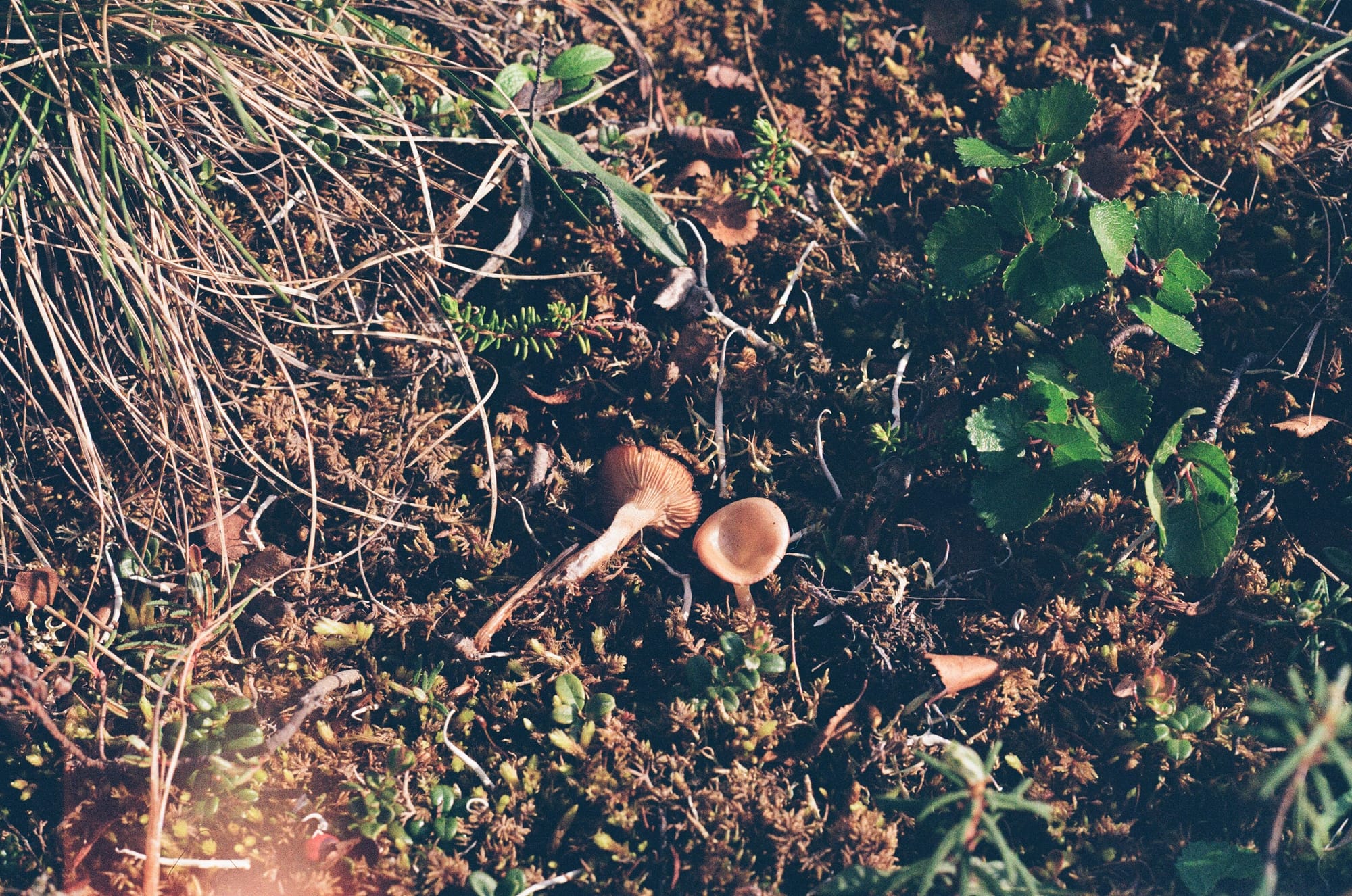
“They need to survive, they need to thrive, and they need to compete with a lot of other organisms,” Hammer said. “They need to make good decisions. And to be able to make good decisions, you have to have some basic form of intelligent reaction to the environment.”
Mycorrhizal fungi conduct the flow of nutrients in the soil like an air traffic controller. The bulk of this control comes from a sort of microscopic programming that allows fungi to direct traffic inside their hyphae. They survive on this nutrient trade. And so do their particular plant partners.
Finding change up and down
On the final day of the Alaska expedition, as we stepped over grassy mounds and thick mats of moss, microbiologist Mario Muscarella called out to the group: “Dwarf birch!” One shin-high shrub with round-toothed leaves flapping like little green flags above a sea of sedge grass. The shrub signaled that something interesting was happening below ground. Dwarf birch have obligate fungal partners: Ectomycorrhizal fungi.
Throughout that day’s southward journey away from the coast on the Dalton Highway, we had seen countless dwarf willows, a similar shrub which (thanks to their fungi) excel at colonizing new territories. This dwarf birch was our first — the northernmost dwarf birch the team logged in their entire survey.
It is unclear how these shrubs’ Arctic fungal partners differ in their populations and strategies. Even less is known about how they’ll adapt to climate change.
As the Arctic warms four times faster than the rest of the planet, tundra life is changing aboveground. It’s getting greener, shrubbier, and woodier, said Katie Orndahl, an ecosystem ecologist at Northern Arizona University who studies Arctic vegetation. Shrubs are creeping north into newly tolerable territory, and away from previously habitable, newly hostile conditions. In northern forests elsewhere, this can mean trees racing further north against a rising curtain of unprecedented heat. But plants can’t migrate without their fungal entourage.
As the Arctic warms four times faster than the rest of the planet, tundra life is changing aboveground. It’s getting greener, shrubbier, and woodier. (Max Levy)
Climate change shrinks the window of mutually tolerable conditions for 35 percent of the tree-fungus partnerships Van Nuland has studied. As a result, last year he reported that trees could migrate slower in response to climate change when their ectomycorrhizal fungi are less diverse. That’s if they migrate at all. Ectomycorrhizal fungi especially buffer plants from changing conditions, but forest-wide adaptations can take centuries to kick in.
That’s why the lone shrub stopped Muscarella in his tracks. The team could literally see the trickling migration along this stretch of the Dalton Highway. Then, at the following stop immediately south: an explosion of dwarf birch shrubs.
The observation invites important questions about the fungi below. “They will be competing. They’re both dwarf woody plants. In some ways, they fill the same ecological niche,” Van Nuland said. They must somehow be differing in their strategies or stress response. Van Nuland’s team hopes to disentangle what these interspecies relationships (and their microscopic chatter) mean for the broader ecosystem.
A more complex idea of conservation
Although fungal studies suggest that mycorrhizae are crucial agents in their ecosystem — and the planet — the takeaway for most researchers is not that fungi redirect all focus belowground, but rather to appreciate the entire system.
“I think a lot about bringing animals into the fold,” said Orndahl, who wonders how incoming herbivores like beavers in the arctic either amplify or temper expansions of plants and fungi. (Dwarf willow is thought to be more palatable to caribou than birch and alder.)
"For a lot of conservation, really, the framework has been very species focused — let's protect polar bears, let's protect spotted owls," Van Nuland told me. "What mycorrhizal fungi really embody is symbiosis, interactions between species. And so we hope that by focusing on mycorrhizal fungi, we can shift the framework of conservation into: let's protect this network of interactions that is critical for the ecosystem to survive."
And there’s still much to learn about the role of specific mycorrhizae in their ecosystem. According to Karst, we may not yet know enough about how to protect them or craft environmental policy in this urgent era. “I’m concerned there’s not enough time,” she said.
But if we knew as much about the diverse roles, behaviors, sensitivities of mycorrhizal fungi as we do about trees, it could overhaul how we understand and restore ecosystems. Agencies could inoculate depleted landscapes intentionally, or use them to protect life in forests. “It means you do conservation differently,” Van Nuland said. “We're at the precipice of having that information for the underground.”

