


By Michael L. Wong
On April 28, NASA administrator Jared Isaacman poked not one, but two hornet’s nests.
In a testimony before a U.S. Senate committee, Isaacman defended the White House’s proposal to slash the space agency’s annual allowance by 23%, including a 46% cut to NASA’s science budget. These reductions are nearly identical to the President’s FY26 budget request that Congress unambiguously rejected only a few months ago. For more than an hour, waves of senators questioned how such a dramatic reduction in support would impact the efficacy and safety of future U.S. space missions, as well as America’s leadership in planetary exploration.
But the controversial nature of Isaacman’s deposition didn’t end there. When Senator Jerry Moran (R-Kansas) tossed in a question about Pluto, the NASA administrator responded, “Senator, I am very much in the camp of ‘make Pluto a planet again.’” The administrator was doubling down on comments made in March about fully supporting President Trump should he issue an order restoring Pluto’s planetary status.

Isaacman’s remarks immediately drew ire from the scientific community. Some say the Pluto debate distracts from real issues facing space science, namely the disastrous nature of NASA’s proposed budget for the next fiscal year. But if you look a little closer, you’ll find the two issues have more in common than meets the eye.
To claim that Pluto is a planet, and to defend the proposed budget cuts to NASA, is to ignore history. The path taken — to Pluto or to a budget proposal — informs an entity’s present state.
The gravity of the situation
In 2006, the International Astronomical Union drew up the current definition of a planet. In its words, eligibility of a celestial body into that pantheon requires that it: (1) orbits the sun; (2) has sufficient mass to assume a round shape; and (3) has cleared the neighborhood around its orbit.
I’ll readily admit that this definition is incomplete — though not for reasons that would restore Pluto’s planethood. If we follow the IAU’s exact words, then exoplanets, which orbit stars other than the sun, are not planets. But surely they are! And the vague “cleared the neighborhood” clause also has counterexamples: Jupiter’s orbit, for instance, contains gravitational traps called “Lagrange points” that house an army of hundreds of thousands of Trojan asteroids that threaten to disqualify the solar system’s most obvious planet from planethood.
Though the terminology of the IAU’s definition can be misleading, its spirit is not. Planets should: (1) be gravitationally bound to stars, such that planet-circling moons aren’t planets; (2) gravitationally pull themselves into a ball, such that misshapen asteroids and comets aren’t planets; and (3) gravitationally dominate their orbital space, such that members of large rings of planetary debris are not planets. It’s this third stipulation that Pluto fails.
Pluto shares its orbital space with the other members of the Kuiper belt — a vast ring of icy planetary building blocks beyond the orbit of Neptune. Just as Jupiter’s disruptive influence never allowed the rocky material of the asteroid belt to coagulate into a single body — that is, a bona fide planet — Neptune’s presence kept Kuiper belt objects (KBOs) in dynamical disarray. Pluto and the rest of the Plutinos, a group of KBOs that are locked in an orbital resonance with Neptune, are bossed around by Neptune’s gravity. Most other KBOs aren’t bothered by Pluto, because Neptune sets the pace.
A similar gravitational hierarchy exists between Jupiter and its Trojans. These asteroids only occupy Jupiter’s Lagrange points because Jupiter’s gravity affords them this existence. The Trojans march to the beat of Jupiter’s drum.
In the end, the IAU’s three criteria come down to: gravity, gravity, gravity. This long-range force determines the relationship a planetary body has to its host star, the shape it assumes, and its association with other objects in its orbital neighborhood.
But while gravity is the immediate reason why Pluto isn’t a planet, the real reason is even more general: how it came to be.
Path-dependent categories
Scientific categorization is the art of lumping vs. splitting: Which things belong together, and which do not? “Planet” is a conceptual bucket into which we toss certain celestial objects (such as Mars, Saturn, and Neptune) but not others (Pluto, the moon, and Haley’s comet, for example). The way the IAU defines a planet says something about what that body of astronomical experts deems important about planethood.
Many proponents of Pluto’s restoration to the planet camp cite its breathtakingly active geology. In July 2015, NASA’s New Horizons spacecraft arrived at Pluto after a nine-year journey. This reconnaissance mission unveiled a frigid world of mountains capped in methane frost, glaciers of churning nitrogen ice, puzzling pitted terrains, world-encircling layers of atmospheric haze, and a possible cryovolcano. Geologically, Pluto is alive, constantly reinventing itself. How could something that looks so planet-like not be a planet? Surely such an intriguing world deserves the title!
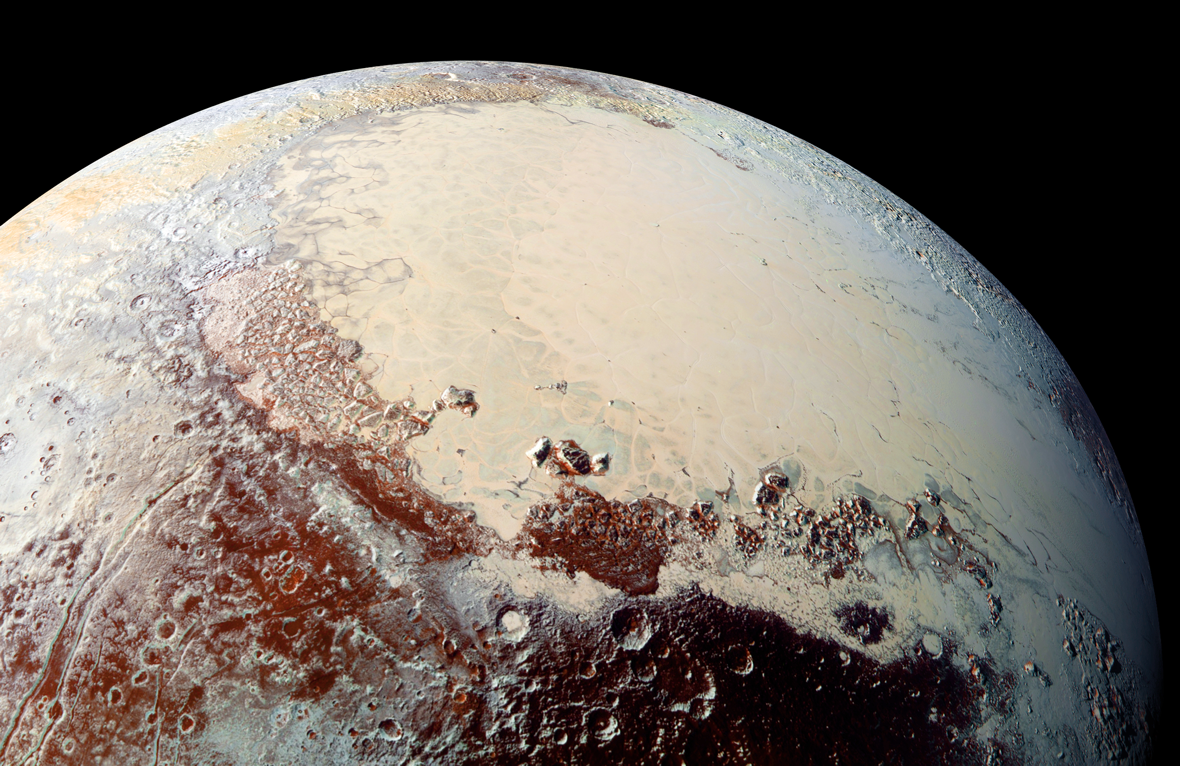
But of the IAU’s three criteria for planethood, only one is intrinsic — the one regarding a planet’s shape. This criterion says nothing about geology, and for good reason: Gas giant planets lack solid surfaces, so terrain cannot be what sets the bar.
The remaining two criteria, on the other hand, are relational. They have nothing to do with the planetary candidate itself. Instead, they query its place in a system of celestial objects — a planet must orbit a star and dominate its orbital vicinity. These conditions reflect the object’s formation and subsequent evolution. By including relational criteria, the IAU is saying: A planet is not just how it looks, but how it became the way it is.
Other important categories in science also contain historical criteria. In biology, the prime unit of evolution is a species — a lineage of organisms that share a common line of descent. I am a member of the species Homo sapiens because I come from a long line of human ancestors. Tigers, humpback whales, and magnolias belong to their own species because their evolutionary lineages are each distinct branches of the tree of life.
Prior to Charles Darwin’s and Alfred Russel Wallace’s insights on evolution by natural selection, which they published contemporaneously in 1858, naturalists grouped organisms by physical characteristics, like body plan and lifestyle. Carl Linnaeus, the father of biological taxonomy, classified whales and other cetaceans as fish in his 1735 Systema Naturae. One can hardly blame Linnaeus. After all, many dolphins and sharks share notable traits, from their gray coloration with white underbellies to their sleek, torpedo-shaped profiles to their diets of small fish and mollusks. Judging by readily apparent properties alone, lumping these charismatic ocean-dwellers together seemed appropriate.
Today, we classify cetaceans as mammals, not fish, because of their distinct evolutionary arc. The ancestors of cetaceans were terrestrial quadrupeds that dipped into the ocean some 50 million years ago. Sculpted by the evolutionary pressures of an aquatic lifestyle, they developed fins, flippers, and hydrodynamic physiques — a classic example of convergent evolution. But whales and dolphins are more closely related to hippos, tapirs, camels, and horses than they are to fish.
Direct connection to ancestral organisms is what defines species membership. Some philosophers of science even contend, on the basis of this relational quality of specieshood, that if you could 3D print a tiger molecule-by-molecule, the result would not be a member of Panthera tigris. It might be a living, breathing tiger, stripes and all, but it would not have the right evolutionary relationship to P. tigris to join its ranks.
The idea that causal history should define biological categories is easy to understand, because biological evolution is sculpted by lines of common descent, where genetic material is passed directly from parents to offspring. But causal history also plays a role in the way we carve up the non-living world.
It applies to minerals, too. My colleagues and collaborators, philosopher Carol Cleland and mineralogists Robert Hazen and Shaunna Morrison, propose that we should classify minerals by their historical nature, rather than merely their present structural and chemical properties. Consider diamond, a simple mineral of pure carbon arranged in a tetrahedral crystal lattice. Cleland, Hazen, and Morrison contend that diamonds formed in the cooling atmospheres of aged stars, diamonds forged under the extreme pressures and temperatures of Earth’s mantle, diamonds that were shocked into existence by large meteor impacts, and diamonds manufactured in laboratories are fundamentally distinct “historical natural kinds.” Lumping the products of these diverse causal processes as “diamonds” would be akin to categorizing whales under “fish” or calling a 3D-printed tiger a member of P. tigris.
In other words, the path is as important as the destination. Many different books can have the same happy ending. But that doesn’t mean they all tell the same story.
More than just semantics
Like a biological species or a mineral natural kind, “planet” is a historical category. What is or isn’t a planet is not merely a matter of semantics. These categorizations illuminate truths about the world: why natural systems came to be the way they are, rather than something else.
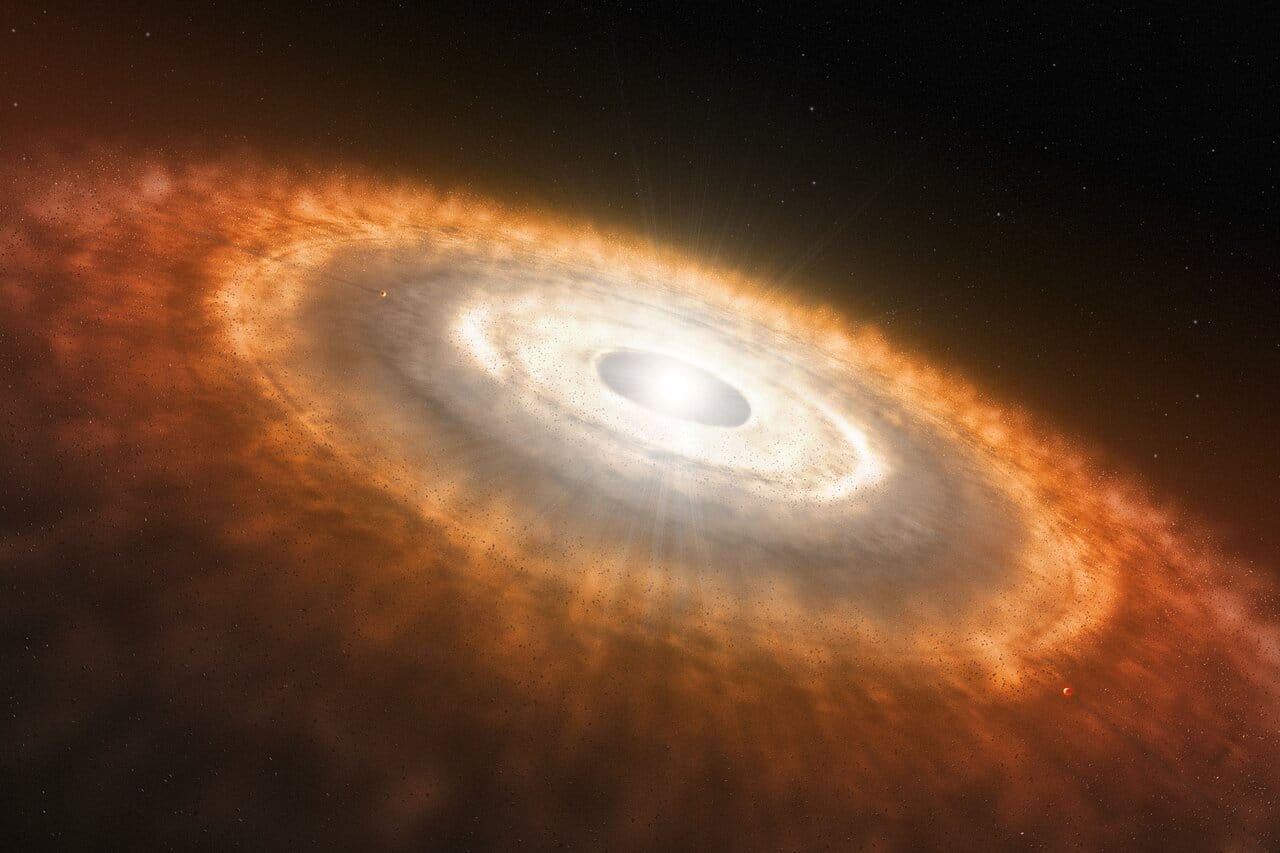
Planets form in pancake-like disks encircling young stars. Within these disks, grains of dust electrostatically cling to one another, growing into small pebbles. Feeling a “headwind” from the disk’s gas, these pebbles clump together like birds fighting against drag. Eventually, flocks of pebbles collapse under their own gravity into a kilometer-sized planetesimals, which then smash into each other to form planetary embryos. Once massive enough, a protoplanet will gobble up the rest of the material in its orbit, creating a gap in the disk. We see such donut-shaped rings around young stars — telltale signs of planets in formation.
KBOs, including Pluto, are the leftover debris of this messy planet-forming epoch. Perturbed by the gravitational influence of the solar system’s giant planets, these small bodies never quite made it to the stage where they could swallow up everything else in their orbits.
Supporters of Pluto’s redemption often decry the IAU’s “orbital dominance” criterion. They point out that if the Earth were suddenly moved to the Kuiper belt, it would no longer be considered a planet via the IAU’s definition. But such a hypothetical scenario misses the point. Instead of artificially moving Earth into the Kuiper belt, one should ask instead why a real Earth-sized planet didn’t form in that region.
The answer: Early in the solar system’s history, the giant planets were restless. Jupiter and Saturn shuffled around until they settled into a cataclysmic gravitational resonance that flung Neptune outward, emptying more than 99 percent of the Kuiper belt in the process. Today, the entire Kuiper belt contains only one percent the mass of Earth, and much of its surviving constituents possess abnormally elongated and tilted orbits around the sun. Planetary scientists use the orbital architecture of the Kuiper belt as a “dynamical fossil” to reconstruct the earliest pages of our solar system’s story.
The fact that Pluto didn’t grow into a planet is not only a genuine feature of our solar system, it’s a meaningful one. Just as knowing that a whale is not a fish helps us appreciate the story of life on Earth, knowing that Pluto is not a planet — that it’s one among thousands of KBOs — helps us piece together the history of our cosmic existence.
Know thy past
To defend Pluto’s planethood is to ignore the history of the solar system. To defend the President’s 2027 NASA budget is to ignore the history of legislation.
Last year, the White House released the 2026 budget request that featured the same draconian cuts to NASA, threatening dozens of space missions and wasting billions of dollars invested in them. Congress rebuffed it unequivocally through bipartisan votes in both the House and the Senate, funding the space agency to previous levels. The message was clear: The American people want NASA to continue to excel.

But in April, the White House threw those same cuts back on the table for the coming fiscal year. The budget request was nearly a carbon copy of last year’s — the major difference being a lack of transparency regarding the space missions and NASA centers that would be impacted.
As Pluto reminds us, to fully understand something is to also put it in the proper historical context, especially when patterns repeat. The first time the White House proposed such destructive cuts, they were just that — destructive. This time, we know the President’s budget request is not only destructive, but unpopular and lazy as well. Such a proposal is an insult to the will of the American people, 80% of whom have a favorable view of NASA and over 90% of whom want the U.S. to lead the world in scientific inquiry.
Any NASA administrator should remember that history matters, both when it comes to planethood and federal science funding.