


Your crap is complicated. Water content aside, up to 50% of the solid weight can come from a tangled mess of microbes — dead or alive. The rest is generally undigested fiber, fats, metabolites, and debris from cells shed from your own innards as they hitch a ride to their next stop in the biogeochemical circle of life via your municipal sewer system (or an 8-inch hole in the dirt somewhere in earshot of your campsite.) Microbiologists have long suspected that each of those components, from specific fats to specific microbes, can reveal something about your health.
Many direct-to-consumer test kits purport to do exactly that. They analyze the diversity of microbes in your poop and identify particular strains. The results may seem good or bad, depending on our still vague understanding of what constitutes good bacteria and bad bacteria.
But just like any other at-home genetic analyses, it’s easy to underestimate the uncertainties. And, according to Stephanie Servetas, a microbiologist with the National Institute of Standards and Technologies (NIST), there are many uncertainties.
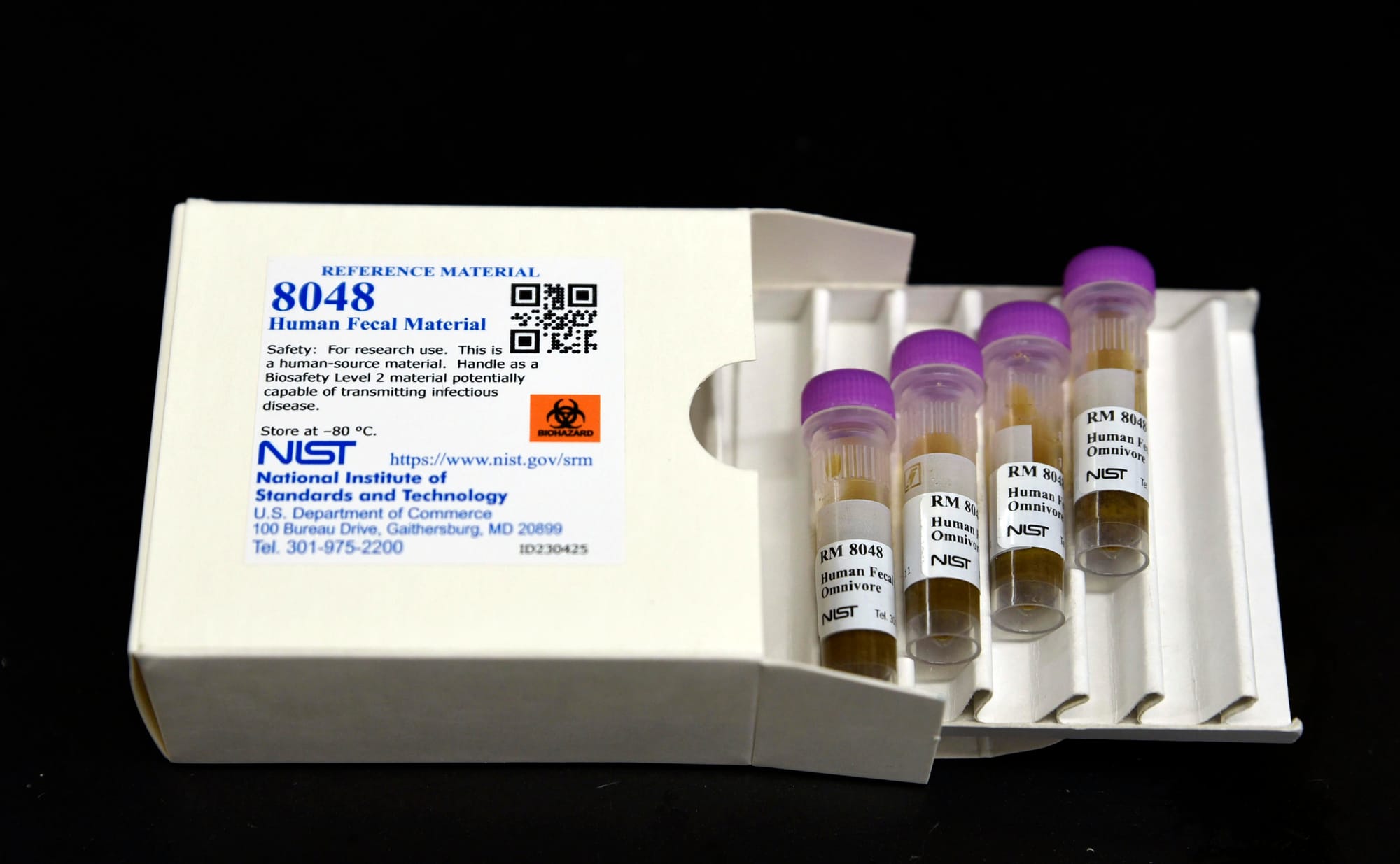
NIST is most well-known for developing official standards for things like time (an atomic clock) and weights. They also create unified standards for materials, from highly pure zinc to peanut butter. One of the newest on their list of over 1200 materials may also be one of the smelliest: the human fecal reference material. Eight vials of liquefied human waste — four from vegetarians, and four from omnivores. Price: $1,027.00.
“This is the first type of this material that NIST has ever made,” Servetas told me. The 5000 total vials have been sold for about 1 year. Once they run out, they’ll make some anew.
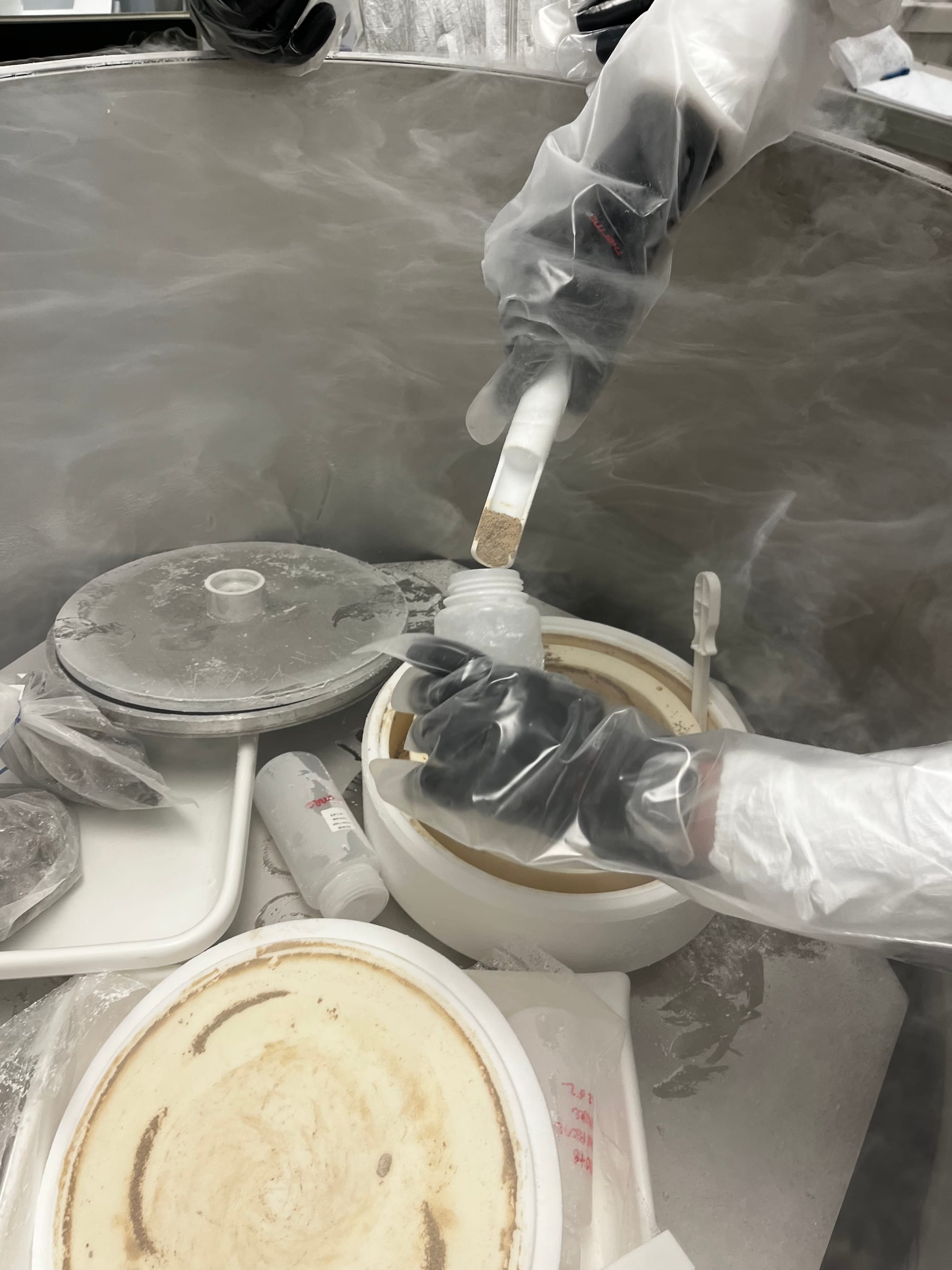
The vials contain actual fecal matter that’s been homogenized, pulverized, refluidized, and otherwise handle-ized to be scientifically identical for every person who buys them. This is not something you’d buy and use at home (I hope). It’s a tool for science. Researchers who either study human waste or those who invent techniques that extract bacterial DNA from poop samples.
The hope is that standard fecal matter can help scientists and poop-test companies be more consistent and and reliable as many people look to better understand (and predict) their health.
I recently spoke with Servetas about… well, why.
The following is a transcript of that conversation, condensed and edited for clarity.
Why did your team at NIST want to standardize fecal matter?
Our focus is on supporting microbiome research. At NIST it’s not so much “bench to bedside” research, we think about “lab to market.” We want to see the development of technologies for the greater good.
The interest came primarily from folks in the nutrition community in 2019. There have been a lot of studies looking at the effect of food on human health through its interactions with the gut microbiome. A lot of questions come up about the comparability between studies and groups that are doing the microbiome research.
The process to get a microbiome measurement is extensive. It's multiple steps, and any one of those, if you deviate from what another group did, then you might get different results.
Where does that deviation come from?
There's not one way to collect a microbiome sample, or even a stool sample. You could collect the whole stool, you could swab it, you could send it off to a company. It probably gets stored somehow or shipped somewhere. Sometimes it gets flash frozen, sometimes it gets put into some proprietary buffer. And that's just step one — I'm just getting the sample.
If you want to know what microbes are in there, you're going to do that by a metagenomic analysis. If you want to know what functional molecules are in there. You might do some sort of metabolomics or mass spec analysis. But no matter what you have to extract something from that sample. And that's not straightforward, and there's lots of different ways to do it.
So because there are so many different bacteria, metabolites, and other stuff in a fecal sample, the only way to truly compare one lab’s work to another’s is by making sure they’re starting from poop samples with the same exact mix of components?
That's really the goal with this type of material. It’s a comparison. We know every researcher [using the vials] has the same material. We've taken the biology out. So if you run your workflow and someone else runs their workflow and you get different answers, it's not because the material was different.
What’s interesting to me about this reference, compared to the thousands of other NIST reference materials, is that you can’t actually say what all is in it.
Some of the other NIST reference materials have a handful of properties that need to be characterized. We have urine that has a certain amount of glucose in it and we know how much. That's a lot harder to do when you're like, well, here's a sample that you measured hundreds of microorganisms.
We don't know every single microbial constituent in our gut microbiome reference material, because we also don't have the perfect DNA extraction kit. Our reference material can't tell you if you're getting the correct answer, because we don't know what the correct answer is.
One of the things that maybe I didn't appreciate was how challenging working with something like this is.
What's it like to work with poop?
Smell is a really common question that we get. I was there for making one of the pilot materials, and it could get a little bit smelly at the early steps, but honestly, probably not as bad as you might expect. A lot of the processing is done with the N95 mask on that's kind of standard SOP when you're doing like the initial, you know, large stool sample kind of blending and cryo homogenization is done in like a bunny suit. Part of that is also to protect the material from us. We're looking for microbes, and so we certainly don't want to add my skin flora into our reference material.
How do you explain what you work on today to your friends outside of science?
We joke about it a little. Like we just made a poop material and our team was affectionately called The Poop Team. It is what it is. It can be hard to make serious, but I talk about it in terms of microbiome studies. This material will help hopefully advance gut testing kits or gut microbiome research.
Your team recently used this new standard fecal sample to compare the reports from different consumer gut-testing kits. Were you surprised by the different results that came from each one?
We know that different companies, presumably using different kits, different bioinformatics pipelines, would get different answers. I think where the disconnect comes is these companies are selling things to the general populace. It’s about the state of the science. How can we introduce things to support this research, to make it better and more translatable?
So having a standard can allow you to identify the quirks of different methods — like this DNA extraction works great for detecting gram-negative bacteria but not gram-positive — then you can evaluate microbiome studies or gut testing kit results with those caveats in mind.
Could this allow us to understand how the workflow may bias the results in some way?
And it’s not meant to be a bash on these companies. I still think it's interesting to get a gut microbiome report. It’s just about knowing what the limitations are. You shouldn't take this to your physician and say “I have this report, and this is what's there.” You have to take it to your physician and say, “Does anything in this report give you an indication of something that could be going on?”
Are we actually there yet? Are we at a place where gut microbiome reports can give our physicians some actionable ideas?
We're probably a little ways off from having it be so straightforward. But if you have a physician that knows about microbiome research they can maybe see if your [gut microbe] diversity is a little low. Or if it shows C. difficile we know that can lead to issues, then maybe your physician wants to do a follow up.
With all that you know about the microbiome, how do you engage with it in your own life or diet? Do you take probiotics?
I am not taking probiotics outside of yogurt. I love fermented foods. That's the route I've gone for probiotics: kefir, sauerkraut, kombucha. I have my own sourdough, I think that's great. Both of my kids have had probiotics — I ended up having both my children by cesarean section, so we decided to incorporate some probiotics for that. I have no idea if they did anything.
One of the things I will say about these direct-to-consumer test kits is a lot of them give recommendations like, “You should eat more fruits and vegetables” and “You should have a high fiber diet. And so in general, that's probably just good advice to have a healthy, diverse diet.
Is the ultimate goal for research and technology in this space to grant more control over health?
I think the big goal here is, in some ways, moving towards personalized medicine and a holistic approach to health. We're coming back around to this idea of organ systems not only working together, but now there are these microbes that are probably impacting how we respond to things. It's just really understanding the whole system. Whether it's a diagnostic tool, whether it's a target for a therapeutic, I think both of those are being opened up to add another wellness feature that doctors can potentially look at.
NIST made 5000 vials of standard poop. What happens when you run out?
This is not the type of material in its current form that we would ever be able to replicate. If this is something that the community needs, then we can make a new batch. Maybe by then the next level of reference material here could be a synthetic gut microbiome — to have the same level of complexity with hundreds of organisms and multiple strains of the same microbe but something that can be manufactured reproducibly.
