


Fast fashion companies have made it possible to get trendy new clothes for a few bucks, but the materials used in this process harm the environment. These garments are traditionally made of polyester and nylon, petroleum-based textiles that release microplastics into the environment. While bacterial cellulose is an environmentally friendly alternative to these textiles, the traditional dyeing process releases 72 toxic chemicals into the water supply, such as formaldehyde, dioxins, and chlorophenols, which cause organ damage.
Dr. Sang Yup Lee, biochemical engineer at the Korea Advanced Institute of Science & Technology, sees an opportunity for his lab to solve this problem with bacteria. One strain would produce a natural textile, while the other would dye it with natural pigments. Their resulting biological recipe, published recently in Trends in Biotechnology, cooks up textiles in 7 different colors, more than any similar approach before it.
The scientists used two types of bacteria. Komagataeibacter xylinus (K. xylinus) naturally produces cellulose. Cellulose is a fiber made of sugar molecules linked together. Cells use it as a rigid material for their cell walls (think of the hard stuff in tree bark and celery) and bacteria use it as protection from the environment. K. xylinus doesn’t produce a lot of bacterial cellulose. Lee and his team solved this problem by giving the bacteria a set of instructions, hacking it to produce more bacterial cellulose than normal.
Lee’s team used Escherichia coli (E. coli) to produce environmentally friendly dyes. They engineered different strains to make 7 colorful molecules, known as violaceins and carotenoids, which each have their own unique color — navy, green, blue, purple, red, orange, and yellow.
These new versions of E. coli and K. xylinus gave the team the correct ingredients; now they needed to find an efficient way of cooking a new textile. This was a daunting task. “These two bacteria have different preferred culture conditions, the nutrients in the medium are limited, and overgrowth of one strain can strongly inhibit the growth of the other strain. We had to optimize all the parameters from the beginning,” says Hengrui Zhou, the graduate student who led the study.
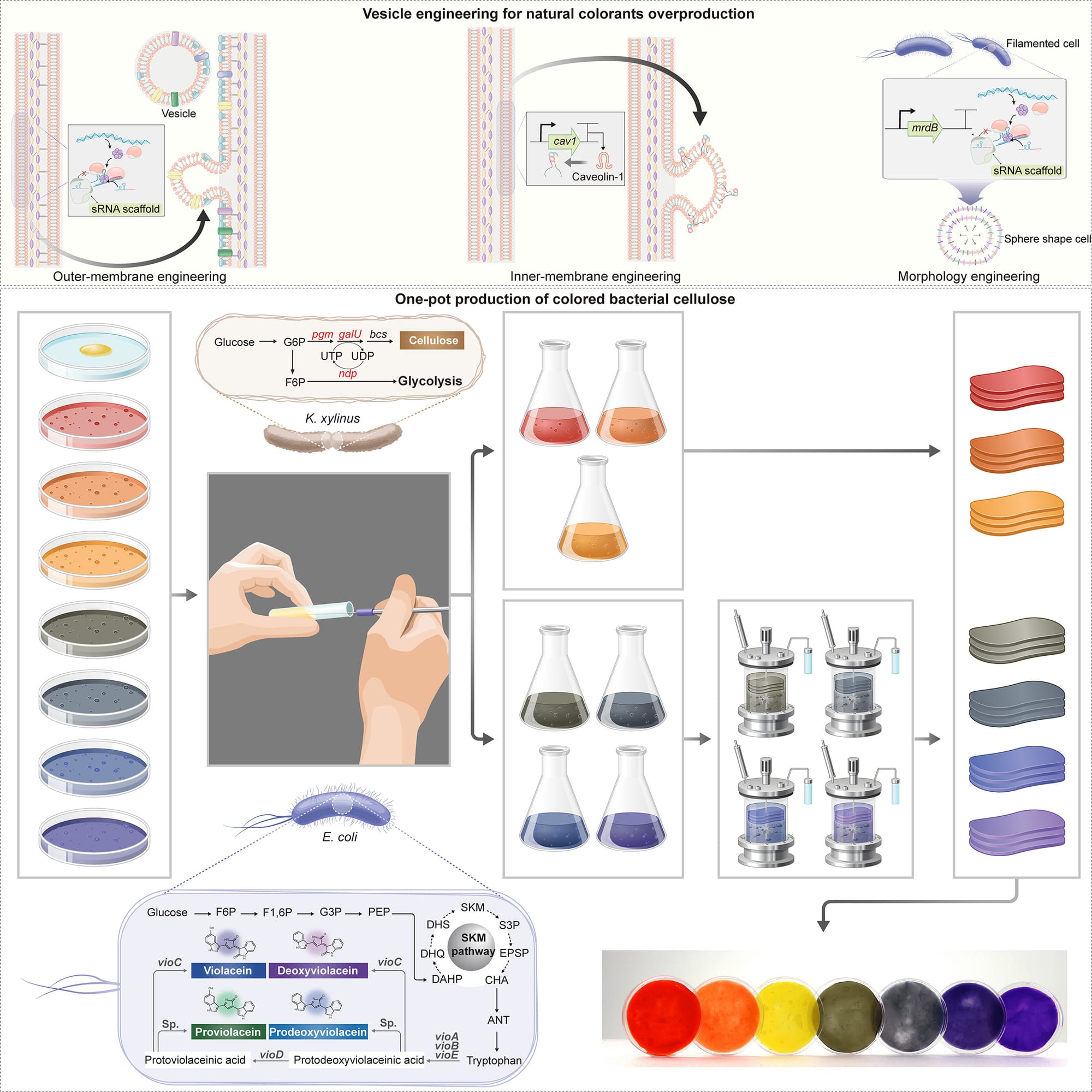
They painstakingly tested how much of each bacterium to add, at which point during the process to combine the bacteria, how much oxygen to supply, the speed used to shake the cultures to distribute oxygen and nutrients, whether the bacteria thrived under basic or acidic conditions, and how long to keep the bacteria together. All the hard work started to pay off, and the scientists found the parameters that allowed both bacteria to flourish. “We were very excited when we first saw bacterial cellulose with seven clearly distinguishable colors,” says Zhou.
At the end of their experiments, the bacterial cellulose looked more like Jell-O than a recognizable item of clothing and the amount of colored bacterial cellulose Lee’s lab produced is not enough for industrial production. But Lee’s team hopes that this environmentally friendly alternative to using petroleum-based textiles and dyes will scale to produce larger quantities in the future.
Lee’s team will combine the 7 existing colorants together at defined ratios, similar to how a painter would mix one part green, one part red, and two parts yellow paint to make a dijon mustard color.
For now, the colors are holding well. To their delight, their colors Lee's team made survived the washing, drying, and treatments with harsh chemicals. “The colors were still vivid and well retained, and that was the moment when we felt truly satisfied,” says Zhou.
This essay was produced through Sequencer's Storytelling Mentorship Program. Your support through donations and subscriptions helps early-career scientists and creatives tell stories you won't find elsewhere.
If you can spare a few bucks, consider enabling us to continue this work with a one-time donation or regular subscription. Thank you.